
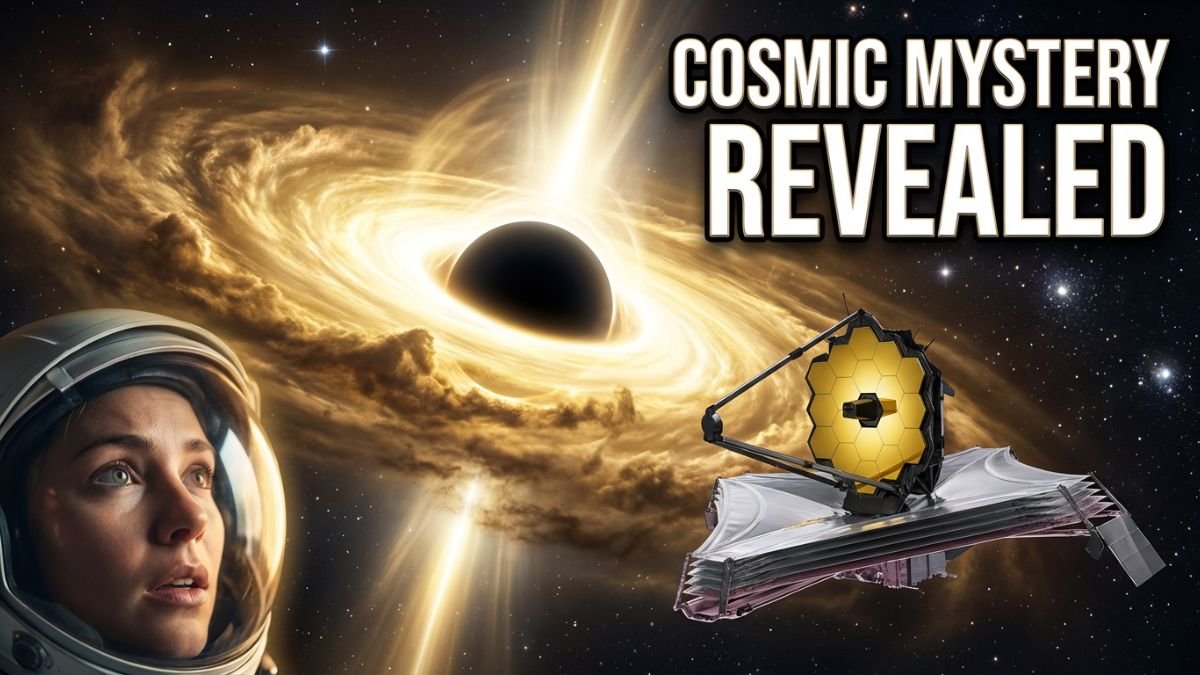
To think of the universe as a world of shining stars, nebulae, and galaxies alone would be an incomplete picture. Deep within, unseen forces are at work, shaping its structure, evolution, and future. The most mysterious of these forces are supermassive black holes. Located at the center of nearly every major galaxy, these monstrous gravitational objects aren’t merely blind wells of matter but rather act as central engines, guiding the entire galaxy.
For a long time, scientists believed that when these black holes weren’t highly active, they lay nearly dormant. But the latest discoveries from the James Webb Space Telescope (JWST) have challenged this notion. This state-of-the-art telescope has revealed supermassive black holes that had remained hidden from conventional instruments. They are quiet, but not ineffective.
Low-Luminosity Active Galactic Nuclei: A Slow-Moving Engine
When a black hole at the center of a galaxy emits a lot of energy and radiation, it is called an Active Galactic Nucleus (AGN). These make the centers of galaxies glow and can be seen from far away.
But not every black hole is so active. Some black holes emit relatively little energy. These are called Low-Luminosity Active Galactic Nuclei (LLAGN). They can be compared to an engine that is not running at high speed but is still making its presence felt even though it is moving slowly.
Previously, they were considered almost inactive. Scientists thought their power had faded into the background. But JWST’s precise observations have revealed that even these “quiet” black holes are exerting a profound influence on their surroundings.

The Power of Infrared: When Even Dust Can’t Block Light
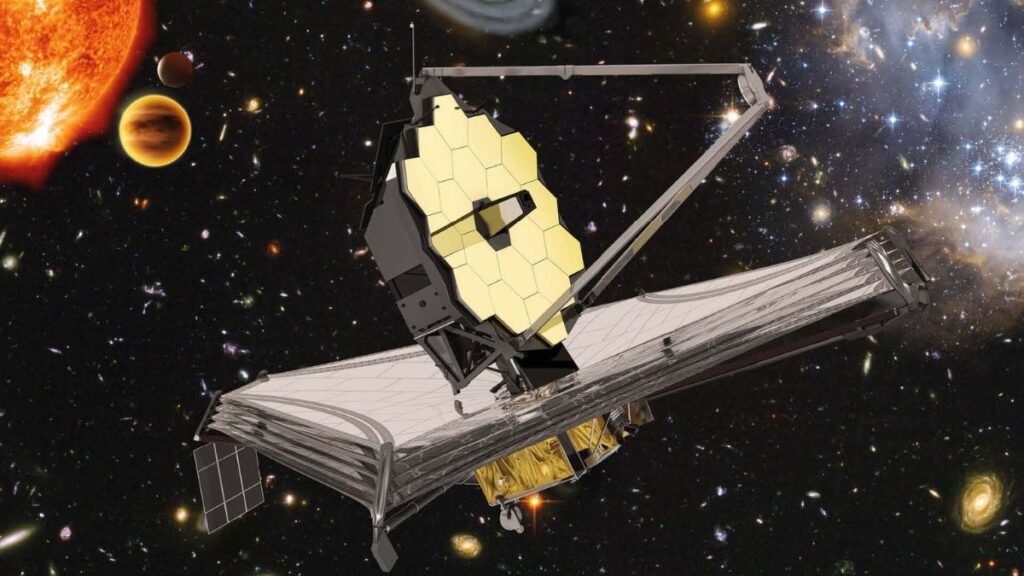
A dense cloud of gas and dust surrounds a black hole, blocking visible light. This is why studying these regions has been difficult for conventional telescopes.
James Webb’s hallmark is its infrared vision. Infrared light has longer wavelengths than visible light, allowing it to penetrate veils of dust and gas. This ability allows scientists to peer into the centers of galaxies.
When the surrounding gas absorbs energy from the impact of a black hole, its atoms become excited. Later, when they return to their normal state, they emit light at specific wavelengths. By studying these emission lines, scientists can understand what elements the gas is composed of, its temperature, and how fast it is moving.
It’s like reading a language. Each line is a word, each spectrum a sentence.
An in-depth examination of seven galaxies
A recent study conducted a detailed analysis of seven LLAGNs and a well-known active galaxy, Centaurus A. Scientists made precise measurements of the infrared spectra obtained from their centers.
These observations revealed that these black holes are not only pulling in the gas around them but also pushing it outward by providing energy. This process is called “kinetic feedback.”
This means that the black hole is an active participant. It heats the galaxy’s gas, changes its speed, and sometimes ejects it. This entire process influences the galaxy’s evolution.
Abnormally Hot Molecular Hydrogen
A very important finding of this research was that the molecular hydrogen gas present in these galaxies was unusually hot. Its temperature was consistently higher than that of other galaxies.
This indicates that even though the black hole is less luminous, it can significantly heat its surrounding environment. This heat can inhibit star formation, as it is difficult for new stars to form in extremely hot gas.
But under certain circumstances, this same energy can also compress the gas, suddenly triggering star formation. It’s a complex dance—sometimes inhibiting, sometimes promoting.
Gas Motion and the Mystery of FWHM
Scientists measured the width of emission lines, called “Full Width at Half Maximum” (FWHM). If the line is wide, it means the gas is highly dynamic or very hot.
These measurements revealed that galactic centers containing LLAGNs are more active than expected. There is chaotic turbulence in the gas, indicating that the black hole is constantly releasing energy.
Changed Scientific Thinking
This research changes a key assumption in astronomy. LLAGNs were previously thought to be nearly inactive, but now it is clear that they also play a crucial role in galaxy evolution.
They influence the birth of new stars, change the composition of gas, and determine the direction of galaxies in the long term.

Another Step Toward Learning the Language of the Universe
This study is only the beginning. Now, scientists want to know if similar hot molecular hydrogen is found in other galaxies. And what other subtle effects these quiet black holes might have.
Instruments like the James Webb are teaching us new languages of the universe. Every new emission line is a story, every new data point a signal.
Conclusion: The immense energy hidden in silence
The James Webb Telescope has proven that no force in the universe is truly dormant. These supermassive black holes, hidden at the center of galaxies, may appear quiet, but they are making their presence felt at every level.
This discovery teaches us that sometimes the greatest powers are those that make no noise. The journey of science is a process of understanding these subtle signals.
The universe is still slowly revealing its secrets. And with human curiosity, modern technology, and continuous research, we are getting closer to understanding those mysteries—starting from a quiet whisper to a great discovery.
FAQs
Q. What did the James Webb Telescope discover?
A. It uncovered hidden supermassive black holes in galaxy centers that were difficult to detect with traditional telescopes.
Q. What are LLAGN?
A. LLAGN (Low-Luminosity Active Galactic Nuclei) are supermassive black holes that are active but emit less light than typical active galactic nuclei.
Q. Why is infrared observation important?
A. Infrared light can pass through dust and gas, allowing scientists to observe regions around black holes that visible light cannot penetrate.
Q. How do these black holes affect their galaxies?
A. Even at low power, they heat surrounding gas, influence star formation, and shape the evolution of their host galaxies.
Q. Why is this discovery significant?
A. It changes the understanding of “quiet” black holes, showing they still play a powerful role in galactic development.
