
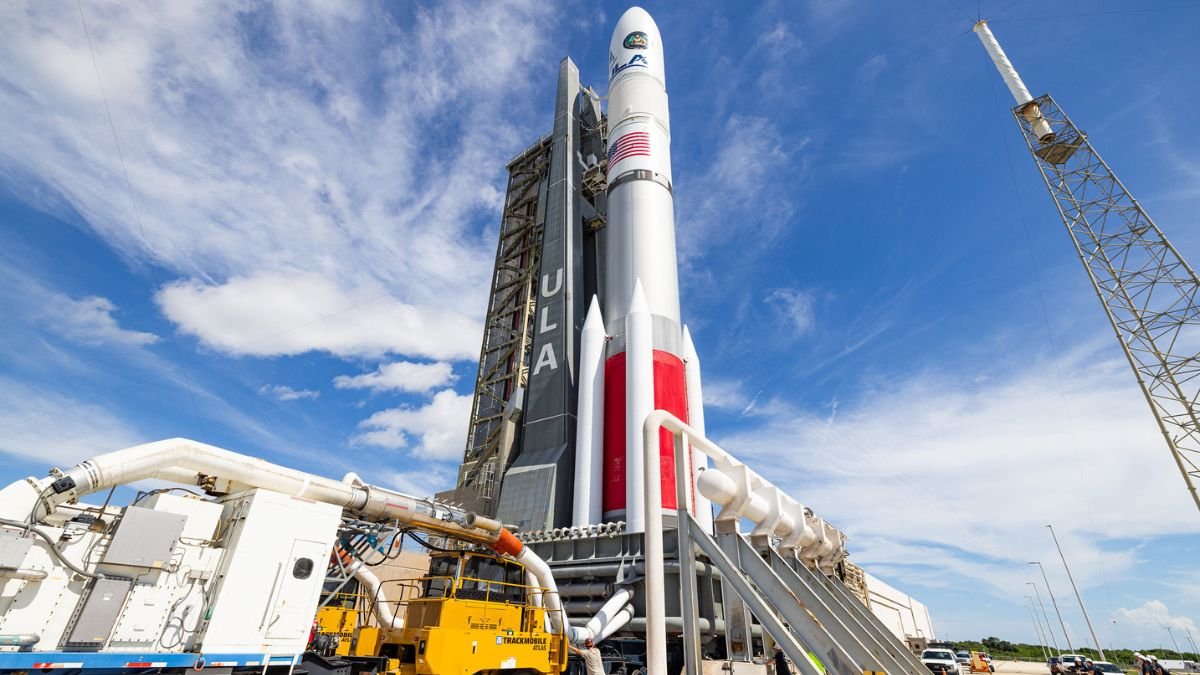
Even bigger news than from NASA? The American space launch company United Launch Alliance (ULA) is once again in the spotlight. The company is preparing to launch rockets from both the East and West Coasts of the United States simultaneously for the first time in a long time. This marks the first time since November 2022 that the company has had simultaneous activity at both launch complexes. This move is seen as a significant indicator of ULA’s increasing activity in the space sector and the expansion of its next-generation Vulcan rocket.
Rocket Hardware Arrives at Vandenberg Base
On Tuesday, the company announced that its transport vessel, known as the R/S Rocket Ship, had arrived at the port of Vandenberg Space Force Base in California. The ship carried the booster and upper stages of the Vulcan rocket, which will be used for the first Vulcan mission to launch from California.
The vessel departed from ULA’s manufacturing plant in Decatur, Alabama, in December with the flight hardware. From there, it first traveled to Port Canaveral in Florida before heading to California in early January. The purpose of this long sea voyage was to finalize launch preparations for the Vulcan rocket on the West Coast.
According to the U.S. Space Force’s Systems Delta 80 unit, the first Vulcan mission from Vandenberg’s Space Launch Complex-3 will be the Space Development Agency’s T1TR-B mission. However, officials say that the mission manifest is constantly changing, so the final mission assignment may still change.
USSF-87 Mission Preparations in Florida
Meanwhile, activity has also intensified at Cape Canaveral Space Force Station in Florida. On Wednesday, ULA integrated the payload for the USSF-87 mission onto a separate Vulcan rocket at the Vertical Integration Facility at Space Launch Complex-41. The main payload of this mission is the GSSAP (Geosynchronous Space Situational Awareness Program) spacecraft, built by Northrop Grumman. This satellite is designed to monitor space systems in geosynchronous orbit, quickly identify and report any anomalies. This is expected to significantly improve space security and surveillance capabilities.
The mission also includes an additional spacecraft, also built by Northrop Grumman. This is a propelled ESPA platform, capable of deploying multiple small payloads directly into geosynchronous orbit in a single launch.
According to the Space Force, these secondary payloads will be used for research, training, and testing new technologies. This will allow Space Force Guardians to refine precision maneuvering strategies in space and confirm the security and resilience of assets in geosynchronous orbit.
Launch Preparations in February
ULA is preparing to launch this mission sometime before February 12th. However, due to the national security nature of the payloads, the exact launch time will only be publicly released closer to the mission date. This is standard procedure for U.S. military and security missions.
Return of West Coast Launch Capability
ULA has been working to re-establish its launch capabilities on the West Coast for some time. In November 2022, the company launched its last Atlas V rocket from Space Launch Complex-3. That mission carried NOAA’s JPSS-2 satellite and NASA-ULA’s LOFTID technology demonstration instrument.
Following that final flight, ULA began modifying the launch pad to accommodate the Vulcan rocket. This process encountered several supply chain challenges, causing delays. However, these issues have been resolved, and preparations for Vulcan launches from the West Coast are now nearing completion.
Major Changes at Vandenberg
The improvements made at Vandenberg included dredging the harbor so that the rocket ship carrying the rocket hardware could safely dock and unload its cargo. Changes were also made to the launch structure.
At Florida’s SLC-41 launch complex, the rocket is rolled from the Vertical Integration Facility to the launch pad. At Vandenberg’s SLC-3, ULA is using a mobile service tower that retracts from the rocket before launch. This system provides a different operational procedure and was specifically designed for Vulcan.
The Vulcan Rocket: ULA’s Next Generation
The Vulcan rocket is considered ULA’s next-generation launch vehicle, designed to replace the older Atlas V and Delta IV rockets. It is designed to be more powerful, cost-effective, and equipped with modern technology. Vulcan is expected to play a crucial role in American military, scientific, and commercial missions.
The company aims to provide more regular and reliable launch services with the Vulcan rocket. The simultaneous preparations on both the West and East Coasts are considered a significant step in this direction.
Conclusion
Overall, this is a crucial time for United Launch Alliance. On one hand, the first Vulcan mission is being prepared in California, while on the other hand, a major national security mission is on the verge of launch in Florida. The simultaneous rocket activities on both coasts for the first time since November 2022 indicate that ULA is entering a new era. The consistent missions of the Vulcan rocket in the coming months could further strengthen the company’s position in the space industry.
FAQs
Q. What is United Launch Alliance (ULA)?
A. ULA is a U.S.-based aerospace company that provides reliable rocket launch services for government and commercial missions.
Q. Why is ULA active on both U.S. coasts again?
A. For the first time since November 2022, ULA is preparing Vulcan rockets at both the East Coast (Florida) and West Coast (California) launch sites.
Q. What is the Vulcan rocket?
A. Vulcan is ULA’s next-generation launch vehicle designed to replace Atlas V and Delta IV rockets.
